Pages

Showing posts with label cook's treat. Show all posts

My Definition of the Verb "to frazzle"

I have been frazzling things in the kitchen for years but whilst preparing this post I looked up “frazzle” in the dictionary for the correct meaning; apparently the primary definition is ...

“to put in a state of extreme physical or nervous fatigue”

I probably did frazzle some of the kitchen staff, including myself on occasion, but that’s not what I mean.

The other definition I found is ...

“cause to shrivel up with burning”

I might have done this too once or twice but I wouldn’t recommend it.

My own personal definition of frazzle is ...

“to fry shreds of an ingredient till crisp”

This sort of frazzling is a great way of using up and enhancing a little bit of this or that to create a snack, cook’s treat, garnish or component of a dish.

I was prompted to write post this by a couple of experiments we did in the pub kitchen where I am now employed making desserts – firstly we sliced a Chantenay carrot lengthways and deep fried it.  Drained, cooled and salted the slices were both pretty and delicious.  

Yesterday, as I peeled a whole case of apples to make loads of apple crumble (the season is upon us – yikes!), I wondered what would happen if we deep fried some of the peelings.  So we did and they were crisp and lovely with caster sugar and a pinch of cinnamon, I think they will be showing up quite a lot on the menu.

I don’t think I have frazzled either of these in the past and have no photos of the above experiments but I have frazzled the following ...

Sweet Potatoes 


To frazzle these I first peel the sweet potato and then using the potato continue peeling until I have a pile of sweet potato ribbons. More ideas for delicious sweet potatoes here.

Leeks


These make a lovely crunchy garnish for creamy leek dishes (see a few great ideas for leeks here). Cut a leek into long thin strips, rub a little cornflour (aka corn starch in the US) through them to help them go crips and deep fry for a few minutes till golden. Lift out of the oil with a skimmer and drain on kitchen roll. Sprinkle with a little crunchy sea salt.

Sage and Parsley


Just drop clean and dry sage leaves or parsley sprigs into hot fat for literally a few seconds, 2 or 3 will probably do it. Drain on kitchen roll and sprinkle with sea salt. Bacon and pork, savoury apple dishes, onions, butternut squash and blue cheese will all benefit from a sage garnish, and the parsley is a great garnish for fish dishes in particular and most other savoury dishes too.

Frazzled Onions which I usually call Onion Grass on menus. 
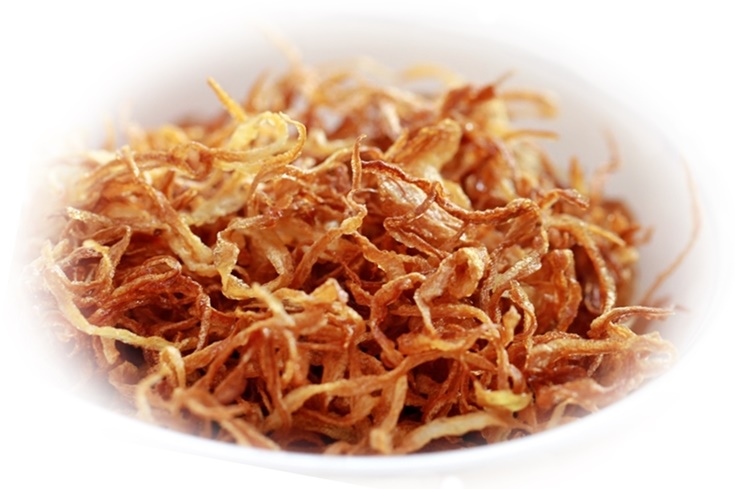

This is a quicker, easier and in my opinion nicer alternative to making onion rings. 

~   Peel halve and thinly slice onions into half-moons.
~   Toss together with seasoned flour – the easiest way to do this is in a bag.
~   Shake off excess and deep fry the onions.
~   Drain well and season.


Chorizo


Fry coarsely chopped, julienned or shredded (or any other shape) chorizo in a little olive oil till crisp.  Remove from the oil and set aside on paper towel to cool and crisp. Sprinkle on salads, soups, pasta dishes, fish and anything else that takes your fancy.

DON’T throw the oil away it will be infused with chorizo and great for drizzling on things such as soup or fried eggs, for instance.  See here for lots more on chorizo including purpose made chorizo oil. 


Prosciutto


Pretty well the same goes with Prosciutto for instance Tagliatelle in Asparagus “Pesto” with Frazzled Prosciutto.


Chicken and Duck Skin – Grattons and Gribenes


These are delicious crispy morsels made from duck or chicken skin. See here for how to make grattons and gribenes and use them to garnish soups, salads, pâtés and general duck dishes or just nibble on them.


Pancakes


Leftover pancakes are great cut into strips, fried till crisp and used to garnish whatever you fancy.


This is just one good way to use up scraps, bits and pieces and leftovers – I have written a book containing literally hundreds of good ideas, suggestions, recipes and tips ~ have a look at my leftovers cookbook Creative Ways to Use Up Leftovers.

the ultimate leftovers cookbook Creative Ways to Use Up Leftovers

Sorry I haven’t posted for a while, by the way, my computer has been having a problem but he’s OK now.

OK - that's all for now, enjoy the sunshine! Let me know if you think of anything else that could do with a damn good frazzling!


Have your Cook’s Treat firmly in mind before you start cooking.

Despite having been aware of the fact, for over half a century, that one day I would become 60 I am still surprised that last Saturday it actually happened! So far I feel just the same ... or do I? 

I just had what may be considered a senior moment! Last night I made a lovely Dark Chocolate Caramel Sauce  to go with homemade double vanilla ice cream (it’s easy peasy and in the book) and homemade choc-chip cookies.


Only seconds after putting the dirty sauce pan in the washing up water this morning I remembered what I should have done with it! Because of the caramel element this leftover sauce sticks quite hard to the pan so the correct way to deal with this is thus ...  


~   Add water (enough to fill your favourite mug or cup and no more) to the chocolatey pan and bring to a boil, stirring to dissolve all the loveliness.

~   Make a cup of coffee with the chocky-water.
~   Sit down, relax, sip and grin.

What a dickhead I am!  This prompts me, however, to remind my readers how very important it is to have your Cook’s Treat firmly in mind before you start cooking.  


If you are unsure exactly what constitutes a Cook’s Treat well, according to Wikipedia, it is 


“ ...a portion of the prepared ingredients not served as part of a dish, but which is nevertheless tasty and enjoyable and may be eaten by the cook.”

Some Cook’s Treat Suggestions


~   Obviously scraping the bowl is a time honoured cook’s treat but have you thought of extending this to the food processor (which, incidentally, I advise you to turn off first)? If I make hummus I wipe out the processor bowl with a piece of good bread and eat it, if I make vinaigrette (see here for lots of ideas) I wipe out the bowl with a piece of lettuce and eat it. And so on.

~   Also obvious is the “checking for quality” of random pieces of fruit as you prepare it.
~   Similar to the above I always (so far, I hope I don’t start forgetting) bake a small tester when making scones, for instance, or cookies. I’m just being greedy assiduous.
~   When starting a new, crusty, delicious loaf it’s quite likely, especially if you concentrate, that the first slice or so will be too small to make a sandwich or toast or it may be that you just have a few crusts over.  Either way dip them into some good olive oil and enjoy yourself.


~   Pastry scraps can be used to make all sorts of treats – see here for lots of ideas and here  for Brown Sugar Doo Dahs which make a pleasant treat for one.


~   Not enough batter left to make a final pancake?  Well fry some "rags" for yourself and drizzle with maple syrup.


~   Chicken Oysters – these are the two little pieces of delicious sweet tender dark meat that you’ll find either side of a whole chicken's backbone. Whilst the chicken is resting and you are waiting for the veggies to be ready scoop these out and eat them unobtrusively over the sink – they might cause you to dribble.  (If you’d like to save the oysters for yourself when cutting up a raw chicken there is some useful info here and remember that other roasted birds have oysters too, of course. 

~   Whilst on the subject of chickens you might as well have the liver for yourself too!  They contribute nothing other than bitterness to any giblet stock you might be making and on the other hand they contribute a great deal to toast, butter and brandy.

Chicken Liver(s) on Toast


~   Remove the liver from the giblet bag and trim it of any stringy and/or greenish bits.

~   Sauté the good bits in a little butter and when turning brown but still a bit squidgy add a spoonful of brandy (away from the flame), a good grind of black pepper and a little salt and turn your liver in it, so to speak.
~   Mash onto a sippet of toast.

~   Chickens again – whilst serving the dinner pop a few scraps of chicken skin back into the oven to crisp up and tease your appetite with them before joining your guests at the table.

~   When slicing cheese it is often a good idea (and is actually de rigueur in the case of Cornish Crackler) to eat any crumbs that fall off accompanied by a sip or two of “chef’s coffee”.


~   Related to the above – you have probably been asked to taste the wine when dining out, don’t you owe it to your guests that you also taste a little before serving it to them?
~   Crispy bacon crumbs should always be eaten by the cook either just as they are or sprinkled onto something accommodating such as ice cream with a drizzle of maple syrup.
~   A spare anchovy is surprisingly good crushed onto hot toast and topped with ... clotted cream!  Ta da!!!
~   Leftover gravy is great finished up by dipping bread into it. 
~   Leftover stew is good on toast even if it’s just the scrapings left on the bottom of the pan.
~   Chocolate – this is taken directly from my book "The Leftovers Handbook"


Although I have given what I believe to be the most commonly held definition of Cook’s Treat Urban Dictionary gives this alternative ...


“Street name for coke used by senior chefs.”

... and I don’t think they are talking the sugar loaded fizzy drink!  I have oft been a senior chef but never took coke in either form and I don’t blame me!


Tweetables

Please click on the links below ...

~   Have your Cook’s Treat firmly in mind before you start cooking.
~   Cook’s Treat Suggestions ~ do you have any more ideas?
~   A spare anchovy is surprisingly good crushed onto hot toast and topped with ... ?

6 New Year (or any time) Resolutions to help you Love your Leftovers

6 ways to make the most of leftover food


I love leftovers, they inspire me, and every day I eat really well by using scraps, trimmings and remains creatively. 

As I  have said before, using leftovers tackles not only the waste of money and resources but also of good eating opportunities.

So, here are 6 rules you might like to adopt this year which are certain to help you make the best of whatever leftover food you have.


1.  Act Quickly with Leftovers


       Deal with leftovers before they have deteriorated – eat, cook and eat, cook and freeze or just freeze but don’t ignore them.

2.   Be a Leftovers Collector


       Group together similar scraps and leftovers in the freezer till you have enough to make something delicious.  Here are some of my freezer collections and what I do with them…

Bread Scraps 


These are great for bread pudding, French toast pancakes, stuffing, bread sauce, and lots of exciting things such as Curried Cashew Fritters.  

spicy roasted cashew fritter made with leftover bread
Loads more ideas where they came from!

Raw Meat Trimmings   


When there are enough I make stock, soup, add them to stir fries, risotto, pasta dishes etc.  Sometimes if the meat is all of good quality I make burgers, not necessary beef burgers, however.  Here is a great recipe using pork trimmings ...

BBQ Pork Burgers


2 rashers bacon – I like smoked
1 tsp paprika
1 tsp dark brown sugar
½ tsp salt
500g good quality pork scraps – minced or fairly finely chopped
1 tbsp oil
BBQ sauce

~   Coarsely chop the bacon and cook, preferably in its own fat, till crisp.  Drain on kitchen roll.
~   Mix together the next 3 ingredients.
~   Form the chopped meat into two or three burgers.  People sometime ask me what I add to burgers to keep them together eg. egg or breadcrumbs but the answer is Nothing. Just munge it lovingly together and all should be well.
~   Rub the burgers with the sugar mix.
~   Brush with a little oil and grill or pan fry till crisp and golden and cooked through – it’s a bit risky under cooking pork.
~   Brush with a little BBQ sauce for the last minute of cooking.
~   Serve on buns drizzled with more BBQ sauce and a great addition is a spoonful of coleslaw on each burger.

Seafood Bits and Pieces - raw and/or cooked  


Fish pie is the obviousest thing to make once there are enough, topped with mashed potato or scraps from my pastry collection.  Less obvious but a really gorgeous use of varied fish scraps is my Seafood Chowder.

rich creamy seafood chowder made from trimmins and leftovers

sugary duck shaped cookie made from pasty scraps


Pastry scraps 


Here are lots of things to do with pastry scraps from crunchy pie topping to Napoleons, Tatins, Turnovers and more.


3.     Be Prepared for Cooking Spontaneously


        Keep a well-stocked store cupboard.  I don’t just mean flour, sugar, oil, salt, pepper and so on although they are crucial but also the flavourings, seasonings and accoutrements you most like to add to a dish. I always have chorizo, black garlic, panko crumbs, chilli pickle, balsamic glaze and one or two other oddments so that I can eat really well whenever I want to.

4.     Be Selfish!


          If your leftover is too small to share and unsuitable for freezing then have yourself a Cook’s Treat, it’s traditional!  There are loads of great ways to enjoy yourself with a little something from simply scraping the bowl to this idea if you have one or two livers just removed from a fresh chicken.

Luxurious Chicken Livers on Toast for the Cook


 ~   Season and sauté in butter till brown outside and pink in the middle.
~    Flame carefully with a touch of Brandy and add enough cream to make a sauce.
~    Mash all together and eat on toast as a lovely sudden lunch.

(Of course you could collect all your chicken livers in the freezer, so long as they are not from a frozen chicken, till there are enough to make a pâté.)

5.     Be Creative with Leftovers


          Leftovers are ideal for playing with as, in the unlikely event that you mess up, well - it was only a leftover so hasn't cost you much. The  more you know, however, the more confidently creative, and less wasteful, you can be so ...

6.      Keep Learning more about Cooking


            Learn about proper storage, learn about best before dates vs. use by dates, learn what goes with what so that if two or more complimentary scraps occur simultaneously you will know what to make.  Above all, however, Learn To Cook, it has one of the greatest boons my life.

Oh, and here's another good idea!  Allow me to present my book on leftovers ...

Creative Ways to Use Up Leftovers


ultimate leftovers food handbook

In Other News ...

I should just like to make my annual joke! 


happy new year joke


How to love a duck!

As you may remember a couple of weeks ago my darling brought home a duck for my sole delectation and as a result I wrote a post on what to do with duck skin and fat which can be so much yummier than one would expect!

This post concerns what I did with the whole duck and that reminds me of a joke my dear departed Daddy used to say ...

Q.   "What's the difference between a fetish and a perversion?"
A.   "A fetish uses a feather, a perversion the whole chicken."

Sorry, a bit off topic there.  So, what did I do with my whole duck?

Firstly I removed all excess fat and then I cut off his (or her) legs and breasts and this is what I did with all the bits and pieces.

Duck Liver Paté and a Cook's Treat


I made myself a cook's treat for lunch.  When cooking professionally I used to store all the duck livers I accumulated in the freezer till I had enough to make Duck Liver Pâté, just like the Chicken Liver Pâté recipe here.  As I didn't expect to be starting a collection, however, I made myself a little something.

duck-liver-pate

~   Trim duck livers by removing anything you wouldn't fancy eating i.e. stringy and/or greenish bits.
~   Sauté the good bits in a little butter and when turning brown but still a bit squidgy add a spoonful of brandy, a good grind of black pepper and a little salt.
~   Serve on a sippet of toast.

Good additions if you have them are balsamic glaze (as shown), black garlic, red onion marmalade or other sweet condiment.

how-to-render-duck-fat


Render the Fat


Chop it up and heat gently in a small pan till all the fat that can melt has melted. Save this fat for confitting the duck legs.


Roast Duck Carcass


I roasted the carcass whilst the oven was on doing something else and then added all the fat it produced to that rendered above.

Duck Stock


Cover the roasted carcass with cold water, bring it to the boil together with some veggie detritus; a bit of onion and carrot, and some black peppercorns, cover and simmer for about an hour. I think a roasted carcass gives a deeper flavour than raw. Turn off the heat, remove  the carcass and set aside till cool enough to handle, but not cold, then strip it of every bit of edible meat; this is much easier done whilst still warm.  Return the meat scraps to the stock  and when cool store in the fridge till needed.  (If any fat sets on the top add it to your collection.) I'm afraid I then threw the bones away.


Prepare Duck Legs for Confitting


Wash and dry your duck's legs,  rub generously with coarse sea salt and freshly ground black pepper and put them in an airtight plastic container in the fridge for 24 hours.  You can add herbs (thyme is good) and garlic. 


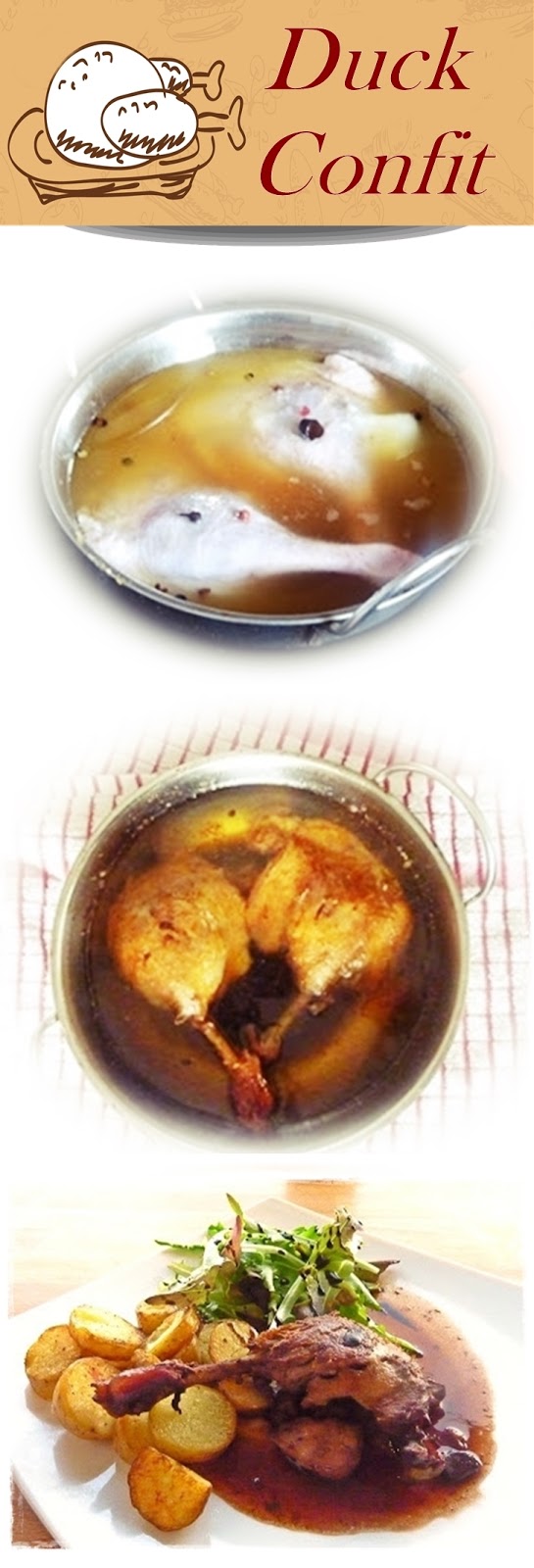
Confit of Duck


Confit the prepared legs thus ...

how-to-confit-duck
Pin this for future reference!
~   Brush off all the salt, pepper and other seasoning (see above).
~   Wash as thoroughly as heck under cold running water and then soak in cold water for 10 minutes, changing two or three times because you really don't want this to end up too salty.
~   Whilst soaking the legs bring all your reserved duck fat to a simmer in an ovenproof pan.  If you haven't enough add some goose fat which can be bought at the supermarket. You need enough to cover the legs (ignore my photos!).
~   Preheat the oven to 275°F/140ºC/120ºC fan/gas 1.
~   Shake the legs dry and add to the simmering fat.  I also added some coarsely chopped black garlic and more black pepper.
~   Cover the pan with a lid or foil and cook for about 2½ hours till utterly tender.
~   Cool to room temperature and then transfer to a clean, dry plastic container and pour over the fat and juices to cover completely.  Chill till needed.

To serve heat a heavy based frying pan, lift your legs, so to speak, out of the fat and put skin side down into the hot pan to sear.  Transfer skin side up to an ovenproof dish and finish warming through in a medium hot oven - about 400ºF/200ºC/180C fan/gas 6, the skin should be crisp.  Have ready some cooked potatoes, toss them in the residual duck fat in the frying pan and roast alongside the duck.  Any unused duck should be kept completely covered by the fat till you need it.  Once you have used all the duck reserve the fat that is left over for next time you do some confitting - or roast potatoes in it.
Happily the duck juices and flavourings form a delicious goo under the fat as the confit cools in the fridge so use a spoonful or two of this to make a sauce for the duck. It can be quite salty (depending on your rinsing prowess) so use abstemiously, tasting as you go. I added a little duck stock (see above) and port to the sauce.

Rumour has it that Confit of Duck will keep for ages; well it doesn't in my house!  Too yummy by far being savoury, tender and unctuous.


Spicy Duck and Cashew Noodle Stir Fry


For this I cheated a bit which, if you are familiar with Sudden Lunch you will know is not typical of me.  I bought some ready cooked Chilli & Coriander Noodles yesterday from M & S.  having procured said noodles I assembled the rest of the stir fry ingredients ...

stir-fry-mise-en-place

Then, as you probably can imagine I ...

~   Stir fried the onion, ginger, garlic and carrot till taking colour and softening.
~   Added the green veggies till bright and lovely.
~   Stirred in the duck meat and noodles and tossed all together till hot.
~   I added the cashew nuts and a little fresh coriander.
~   Tasted the concoction and added a little Sweet Chilli Sauce and a dash or two of soy sauce.

stir-fried-duck

This was very delicious!  I didn't use all of the noodles so was able to make ...

Duck Noodle Soup


spicy-duck-broth
~   Remove any fat on the surface of the duck stock.  Separate the duck meat from the stock keeping both.
~   Put the stock into a small pan together with some seasonings of your choice, I add a little finely grated ginger and bring to a simmer.
~   Add finely sliced fresh green veg - I used 2 mange tout, a broccoli floret and half an asparagus spear.
~   Simmer all together till tender.
~   Taste and season - a dollop of Sweet Chilli Sauce is good here (speaking of no cheating!).
~   Add a handful of cooked noodles, the duck meat you have set aside and some chopped fresh coriander.
~   Bung it in a bowl.

I went a bit fusion because I do like some crunch with my food - I shredded and crisply fried half a poppadom.

So there you have it; how to have your wicked way with a duck!  I still have one leg and one breast to eat so that will make umm ... 7 meals for lucky me. Yippee!

Incidentally I still didn't use all of the noodles but it's OK, I have plans!